When a cannabis lab report lists “alpha-pinene” versus “beta-pinene,” it sounds precise. It sounds meaningful. But in practical terms for both consumers and budtenders, the distinction is mostly noise.
What the “Alpha” and “Beta” Actually Mean
Pinene is pinene. Both alpha- and beta-pinene share the same molecular formula (C₁₀H₁₆) and are extremely similar in structure. The “alpha” and “beta” designation refers only to a double bond in the molecule. A tiny difference that gives them a small structural variation that slightly changes boiling point and aroma nuance.
Alpha-pinene smells like a damp pine forest, almost like water sitting under a Christmas tree.
Beta-pinene leans a bit fresher and greener, sometimes slightly basil-like.
In aromatherapy and cannabis science, both are treated as functionally similar. Aromatherapy research shows they share overlapping biological effects like bronchodilation, anti-inflammatory activity, and possible effects on memory retention.
In cannabis flower, pinene just smells like pine. Whether a lab reports 0.3% alpha or 0.2% beta won’t meaningfully change your experience.
The same logic applies to caryophyllene.
Beta-caryophyllene is the biologically active, well-studied sesquiterpene, known for binding directly to CB2 receptors (making it behave like a dietary cannabinoid).
Alpha-caryophyllene (also called humulene) is a separate compound with an earthy, hoppy profile.
Lab reports may separate or group them, but when dispensaries say “caryophyllene,” they almost always mean beta-caryophyllene. The distinction is chemistry trivia, not something that changes consumer experience.
The 14 Terpenes That Actually Matter
Rather than getting lost in prefixes, it helps to zoom out. Cannabis produces hundreds of terpenes, but the vast majority appear at concentrations too low to meaningfully contribute to effects or flavour.
Across the full diversity of cannabis cultivars, there are roughly 14 core terpenes that consistently show up above meaningful thresholds. This means they are present at concentrations where they actually influence smell, flavour, and potential interaction with the endocannabinoid system. These are the ones worth focusing on.
Earthy, Woody, and Spicy Group
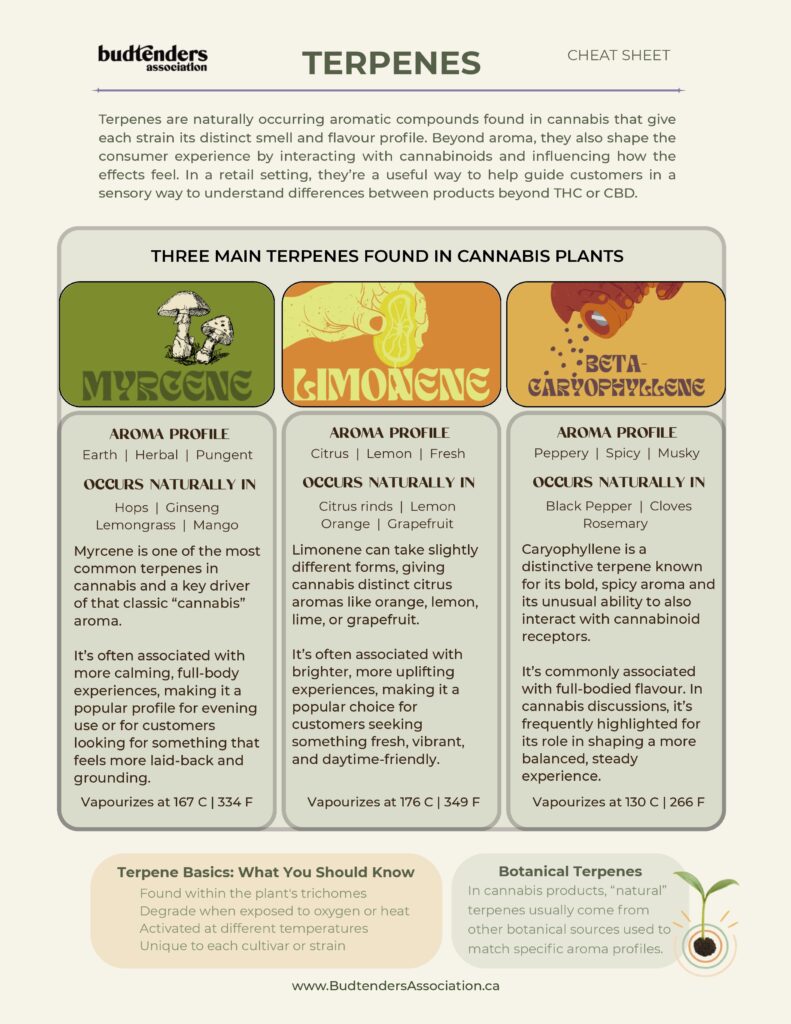
Myrcene – The most common terpene in cannabis. Dank, musky, clove-like.
Caryophyllene – Peppery, spicy, woody. It is unique among terpenes in that it binds CB2 receptors directly, giving it a genuinely cannabinoid-like action. It is also the most abundant in cannabis alongside Myrcene.
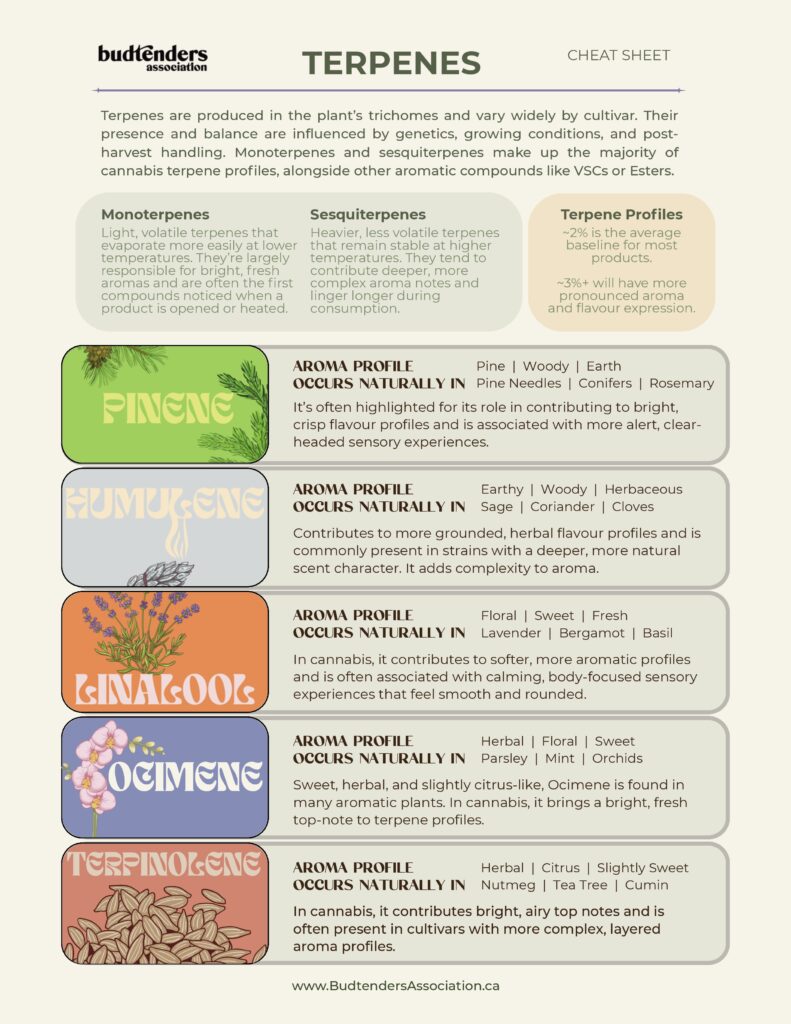
Humulene – Earthy, hoppy, slightly dry. Often found alongside caryophyllene.
Bisabolol – Rounds this group out with soft floral, chamomile-like, calming aroma.
Citrus, Sweet, and Bright Group
Limonene – One of the most widely studied terpenes in both cannabis and aromatherapy. Lemon-orange aroma. Well-studied for mood and stress effects.
Valencene – Sweeter citrus (like Valencia orange), tends to appear in tropical and citrus-forward cultivars.
Geraniol – Floral, rose-like sweetness. Found in more perfumed cultivars.
Pine, Fresh, and Green Group
Pinene (alpha + beta grouped together) – Pine forest, sharp and fresh.
Ocimene – Herbal, slightly sweet, sometimes tropical-green freshness.
Floral, Lavender, and Herbal Group
Linalool – The primary terpene in lavender and one of the most thoroughly researched in aromatherapy, widely studied for calming and anxiety reduction.
Terpinolene – Complex mix of pine, citrus, floral, and herbal notes; tends to be dominant in Haze-lineage cultivars.
Cooling and “Medicinal” Group
Eucalyptol – Minty, sharp, camphoraceous quality. It is the same compound that makes Vicks VapoRub smell the way it does.
Borneol – Camphor, mint, and earth; used in traditional Chinese and Ayurvedic medicine for centuries.
Nerolidol – The softest of the group. It’s woody, floral, and waxy simultaneously, like bark and roses combined.
Why These 14 Terpenes Matter
The reason these 14 matter more than the full 200+ terpenes detected in cannabis is threshold and synergy.
Most minor terpenes appear below about 0.05% concentration, which is often too low to meaningfully affect smell or physiological response. They are essentially fragrance ghosts. Present, but not contributing meaningfully to physiological effect or even to detectable aroma. The 14 above appear regularly above that threshold and have enough research (much of it from aromatherapy, cosmetics, and food science) to have identifiable profiles.
Everything below 0.05% tends to be “background chemistry” rather than experience-shaping compounds.
The Aromatherapy Connection
Aromatherapy research is actually one of the best foundations for understanding cannabis terpenes. It’s not the cannabis industry itself, but the century-plus of aromatherapy and essential oil research that predates it. In that field, practitioners don’t obsess over alpha vs beta isomers. They work with the whole plant terpene profile of an oil:
Lavender → dominated by linalool and linalool acetate (an ester)
Frankincense → rich in alpha-pinene with boswellic acids
Black pepper → high in beta-caryophyllene. Some aromatherapists have used black pepper essential oil for CB2-related anti-inflammatory applications for decades without knowing anything about the receptor mechanism.
The point is that aromatherapy literature has long understood what cannabis science is slowly rediscovering: terpenes work together, not in isolation. The cannabis industry is still catching up to this idea, and the nuance of a single isomer prefix tells you almost nothing about the lived effect.
Terpenes Aren’t the Whole Story
Here’s the bigger issue, and the one that makes parsing alpha vs beta pinene almost absurdly granular: terpenes are not the only aroma and flavour compounds in cannabis. They’re the loudest voices in the room, but not the only ones. Focusing only on terpenes alone, leaves out major contributors to cannabis aroma and experience.
Esters: The Fruity, Candy-Like Compounds
Esters are a major secondary class. These are what give many fruity, candy, and tropical cannabis cultivars their character. Esters include compounds like:
Isoamyl acetate → banana
Ethyl butyrate → pineapple
Methyl anthranilate → grape
These show up strongly in certain cultivars like Zkittlez and Runtz lineage, but they’re largely absent from standard terpene panels because most lab testing doesn’t screen for them. A strain can smell intensely fruity with very “average” terpene percentages.
Volatile Sulphur Compounds (VSCs): The Skunk Factor
VSCs are one of the most important but least discussed drivers of cannabis aroma. For example, compounds like 3-methyl-2-butene-1-thiol (3MBT) is responsible for classic “skunk” smell and appear in cannabis at concentrations magnitudinally below the detection threshold of standard terpene testing. However they are detectable by humans at extremely low concentrations (parts per billion). A single part per billion is enough for most people to register skunkiness. This means a cultivar’s characteristic “skunk” note is essentially invisible to the lab panels, yet they dominate aroma perception.
“Tropical skunk” notes in some cultivars also come from related sulphur compounds, sometimes called Tropicanna Sulfurs. Found in tropical-lineage cultivars, they are another specific subset or aromatic compounds that produce the onion-meets-tropical fruit character, which all standard terpene tests completely miss.
Flavonoids and Phenolics: The Quiet Contributors
Compounds like Cannflavins, Quercetin, and others, contribute bitterness and astringency. They are important, but rarely discussed in cannabis aroma education.
Aldehydes, Alcohols, and Ketones: The Green Notes
These compounds round out the scents and shape “fresh” plant aromas. They are especially noticeable in uncured or freshly dried cannabis.
Hexanal → fresh cut grass
(E)-2-hexenal → sharp green smell
Various alcohols → hay-like or vegetal notes in uncured or freshly dried cannabis.
The Aroma Hierarchy Simplified
Think of cannabis chemistry like a pyramid of awareness:
Top (most measured): Terpenes
At the top, terpenes are the largest and best-understood group with the 14 major compounds are consistently present above meaningful thresholds, well-studied across both cannabis and aromatherapy literature, and captured reasonably well by standard lab panels. This is also where the alpha/beta isomer distinction lives, and as discussed, it sits at the very fine-detail end of a category that offers diminishing returns the deeper you go.
Second layer: Esters
Below terpenes in terms of research depth, they are the fruity, candy-like compounds that drive some of the most recognizable flavour profiles in modern cultivars but are largely invisible to standard testing.
Third layer: Volatile sulphur compounds
Extremely potent aroma drivers like skunk, present in vanishingly small quantities by weight, wildly disproportionate in their impact on aroma. Entirely absent from lab reports.
Fourth layer: Flavonoids & phenolics
Bitterness, astringency, and subtle biological effects. They receive almost no attention in cannabis education.
Base layer: Aldehydes, alcohols, ketones
The fresh-cut grass, hay, and green vegetal notes that shape the character of uncured or freshly dried cannabis. They disappear entirely from the conversation once a product hits a dispensary shelf.
The pyramid reflects how well we study and measure these compounds, not how important they are to the plant itself or consumer awareness. In fact, The sulphur compounds near the bottom may be doing more to define a cultivar’s recognizable character than the terpene panel at the top!
The practical takeaway is that the further down this hierarchy you look, the less the industry currently measures, discusses, or understands.
Don’t Overthink the Prefix
So when thinking about the differences between alpha versus beta pinene, the most honest answer is that the prefix tells you almost nothing useful. What tells you something useful is knowing that a cultivar is pinene-dominant with pine-forward aromatics and flavour.
The takeaway here is understanding that the terpene profile on packaging is the best-mapped part of cannabis chemistry, but it is still only a partial map. Some of the most expressive, memorable cannabis flavours and aromatics come from compounds that don’t even show up on the test sheets.