member Archives - Page 4 of 7 - Budtenders Association (BTA) – Learn & Earn™
Welcome to Budtenders Association
This website contains cannabis-related content intended for adults. To continue, please confirm that you are of legal age to access cannabis content in your province, territory, or country.
We connect Budtenders, consumers, and brands to help shape the future cannabis.Become a Member
Growth does not happen by accident. It is built through intention, learning, and the willingness to stretch beyond what feels comfortable. Whether you are looking to strengthen your leadership skills, elevate your career, expand your professional toolkit, or deepen your personal development, this curated list of completely free courses is designed to help you take the next step with confidence.
Below, you will find organized learning opportunities across three core areas: building your brand, building your career, and building yourself. Each section supports a different dimension of growth, but together they create a well-rounded path toward long-term success.
Build Your Brand
Strengthen your professional presence, entrepreneurial confidence, and creative capabilities. These courses focus on visibility, marketing, communication, and business fundamentals.
Advance professionally with practical workplace skills, career strategy, and leadership development tools. These courses focus on employability, advancement, and influence.
Professional success is not built on one skill alone. It is shaped by how you communicate, how you lead, how you adapt, and how you care for your own well-being. Use this list as a starting point. Choose what aligns with your current goals, and commit to consistent development. Small steps in learning lead to lasting transformation.
Alright, budtenders, let’s talk about the holy grail of cannabis retail: loyal customers who come back for more and it’s not because they forgot their wallet the first time. Cannabis isn’t just another consumer product. It’s an experience, a ritual, a wellness tool, and YOU are the guide on their journey. You know budtending is more than selling weed. So, how do you turn a new buyer into a lifelong regular?
1. Start With a Great First Impression
Greet every customer like they’re a new friend, but keep it professional.
“Hey, welcome in! Shopping for something specific today or just browsing?”
This is your chance to read the room. Are they a newbie needing a full breakdown, or a seasoned smoker who just wants to grab hight THC and dip? Either way, a warm, confident approach makes all the difference.
Pro Tip: Notice their body language. Someone avoiding eye contact and hovering near the entrance? Might need a softer approach. Someone walking in like they own the place? They’re probably ready to chat strains with you.
2. Listen More Than You Talk
Instead of launching into a monologue about terpenes and trichomes, ask questions.
“What kind of experience are you looking for?” “How do you usually consume cannabis?” “Any favourites so far, or are you open to exploring?”
The more you understand their needs, the better your recommendation. People don’t come back for basic service; they come back because they feel heard.
Pro Tip: Repeat their preferences back to them. “Got it, you’re looking for a chill, couch-friendly indica with a citrusy vibe? I have just the thing.” Boom. Trust unlocked.
3. Recommend, Don’t Push
Ever walked into a car dealership? Yah… no one likes a pushy salesperson. Give them options, explain the differences, and let the customer decide.
“You HAVE to try this. It’s the best one.” = Too aggressive. “Based on what you said, I think this strain could be a great fit for you.” = Friendly suggestion
Tip: Have a go-to “if you like this, you might like that” suggestion ready. People love a solid recommendation from someone who knows their stuff.
4. Educate Without Overwhelming
Yes, you know the entire chemical breakdown of every strain in your shop. No, the customer does not need a full-on science lesson unless they ask for one.
Make the complex approachable. Knowledge is power, but clarity is king. Stick to simple, relatable descriptions: “This one’s great for winding down at night.” “This will keep you uplifted and creative.” “This edible kicks in slowly, so take it easy.”
Pro Tip: Have a fun fact ready! “Did you know that pinene, the terpene in this strain, is also found in pine trees and rosemary? That’s why it smells so fresh!” Who doesn’t LOVE little nuggets of info.
5. Keep the Conversation Going
Encourage them to come back by making the experience memorable. Its the first step to building a community.
“Try this out and let me know what you think next time you’re in!” “We’ve got some new strains dropping next week—might be right up your alley.”
Tip: If your store has a loyalty program or events, mention them! “We’re running a terpene tasting next Thursday—come check it out!”
6. Follow Up (But don’t be weird)
If your store tracks purchases, use that data wisely. Personalized service goes a long way. For example, if a regular always buys fruity sativas, and you get a new one in stock, make a note to mention it next time they visit.
“Hey, we just got a new strain that reminds me of what you got last time. Want me to set one aside for you?”
This makes the customer feel valued and remembered, not just another sale.
7. Be Authentic
People don’t just return for the product. They return for the experience. And YOU are a huge part of that. If you genuinely enjoy helping people, it shows.
✅ Be yourself. ✅ Share your enthusiasm for the plant.
At the end of the day, budtending creates connections. Customers want to feel comfortable, informed, and excited about their choices so why not make every interaction count?
Every customer who walks through that door is looking for something. Whether it’s relief, creativity, relaxation, or just a good time, you have the power to guide them to a great choice. Stay lit, stay knowledgeable, and keep making magic happen.
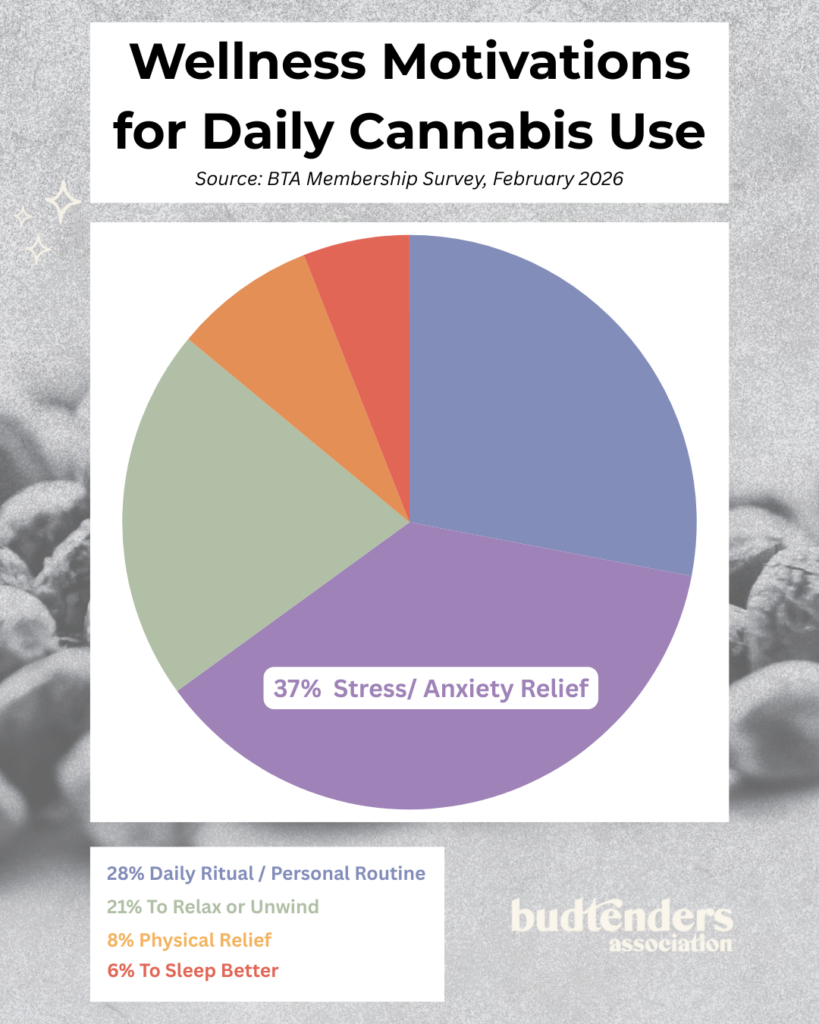
Based on responses from members using cannabis for wellness.
Among our members, stress and anxiety relief is one of the most prominent wellness-driven reasons they consume cannabis. This highlights the plant’s central role in emotional regulation and everyday wellness for people who generally consume it daily. Some reach for it to unwind after work, others during creative projects, and others in moments of emotional overwhelm.
While cannabis is often considered recreational, its effects on stress, anxiety, and mood are biologically complex and highly individual. Research shows that cannabis interacts with the body’s stress systems, sleep cycles, emotional processing, social behaviour, and cognitive flexibility.
Here is what science is currently telling us about cannabis and stress, and some practical ways to think about the plant as part of a broader mental wellbeing toolkit for stress and anxiety relief.
Cannabis and the Body’s Stress Hormones
Stress is a biological process. When the brain senses a threat, it releases cortisol and other stress hormones to prepare the body for action. Short bursts of this response are helpful and adaptive. Repeated or prolonged activation may contribute to anxiety, burnout, sleep disruption, and emotional challenges.
Cannabis works through the endocannabinoid system, a regulatory network that helps maintain balance across mood, appetite, sleep, immune function, and stress responses. Cannabinoid receptors are concentrated in brain regions that manage fear, emotions, and decision-making, including the amygdala and prefrontal cortex. This explains why cannabis can influence feelings of calm, focus, or heightened sensitivity depending on the individual.
THC and CBD affect stress systems in distinct ways. THC can increase cortisol, especially at higher doses or in unfamiliar situations. This can create feelings of alertness or anxiety for some people. Simultaneously, THC may reduce activity in the amygdala, lowering emotional reactivity and creating a sense of calm under pressure.
CBD works differently. It does not produce intoxication and appears to reduce excessive stress responses by influencing serotonin signaling and regulating endocannabinoid levels. Research suggests CBD may help people with elevated stress manage cortisol responses without changing baseline levels in relaxed individuals.
Together, these effects help explain why cannabis can make stress feel quieter or more manageable. Cannabis doesn’t remove the stressor, but it changes how the body and brain respond to it.
Cannabis as a Wellness Tool
Many people incorporate cannabis intentionally into routines focused on wellbeing. Research shows that it can influence mood regulation, stress perception, and emotional tone.
CBD is being studied for its potential to support mental wellbeing. Evidence suggests it may reduce anxiety, support emotional regulation, and improve sleep, especially in people already experiencing stress or anxiety. Its effect on serotonin signalling mirrors mechanisms seen in some anti-anxiety medications, but works more subtly.
THC can also support wellbeing when used thoughtfully. Low to moderate doses may reduce perceived stress, improve mood, and increase enjoyment of everyday experiences. Higher doses can increase anxiety, racing thoughts, or emotional overstimulation. Cannabis also influences dopamine, which affects motivation, pleasure, and reward. This helps explain why it can make activities feel more satisfying, though habitual use may change motivation over time.
Flow, Creativity, and Emotional Flexibility
Flow occurs when attention, enjoyment, and effort align. Many people report that cannabis helps them enter flow, especially during creative activities.
THC may enhance divergent thinking, allowing users to generate multiple ideas and perspectives. Cannabis can reduce self-criticism and performance anxiety, helping ideas surface without immediate judgment. This is helpful for art, writing, music, brainstorming, and exploratory practices.
Practical tips for creative wellbeing include using low doses, setting a clear intention, focusing on the process rather than the outcome, and trying exercises such as free-writing, doodling, improvising music, or movement-based expression. Cannabis tends to support flow when it encourages curiosity without overwhelming focus.
Cannabis also enhances emotional flexibility. Emotional flexibility is the ability to adapt to changing circumstances and respond to stress without becoming rigid. THC may reduce habitual thought patterns and allow users to reframe stressful situations or see problems from new perspectives. Improving mood and lowering threat perception can open space for flexible thinking, problem-solving, and coping.
Cannabis and Sleep
Sleep is critical for emotional regulation and stress resilience. Poor sleep increases anxiety, reduces coping capacity, and amplifies stress. Many people use cannabis to help fall asleep or wind down, and short-term relief is common.
Cannabis may reduce the time it takes to fall asleep by calming the nervous system and quieting mental chatter. THC can increase drowsiness, and CBD may reduce anxiety that interferes with sleep. Extended or regular use may change sleep patterns, reducing REM sleep and increasing nighttime awakenings. REM sleep is essential for emotional processing and stress integration.
Cannabis can support sleep when used strategically, particularly during periods of acute stress. When it improves sleep quality, it may indirectly strengthen stress resilience by restoring emotional balance and cognitive flexibility. It works best alongside good sleep hygiene such as consistent bedtimes, reduced evening stimulation, and daytime stress management.
Social and Cognitive Effects
Cannabis can influence social experiences. Many users report feeling more relaxed, empathetic, or connected in groups. Cannabis may reduce amygdala reactivity, lowering social anxiety for some individuals. Emerging evidence suggests it interacts with oxytocin systems that support bonding, though more research is needed.
Cannabis also affects attention, perception of time, and memory. Many users notice time slowing down, which can reduce stress by focusing attention on the present. It softens mental time travel, helping reduce rumination about the past or anticipatory anxiety. Attention narrowing can make multitasking difficult but supports mindfulness when focused intentionally. Understanding these shifts helps explain why cannabis may feel calming in some situations and disorienting in others.
Building Emotional Resilience with Cannabis
Emotional resilience is the ability to respond skillfully to stress. Cannabis can support resilience when used thoughtfully as part of a broader toolkit.
Practical strategies include starting with low doses, prioritizing CBD-rich products for anxiety-prone individuals, and choosing strains or formats that match the desired outcome. Pairing cannabis with grounding practices such as breathing, stretching, music, or journaling enhances its benefits. Cannabis works best when it complements routines rather than replacing them.
Observing What Works
For many of our members, the benefits of cannabis for stress and anxiety are already clear through experience. Our survey shows that daily use for relief and wellness is common. You do not need to understand all the science to feel its effects, but knowing how it works can be fascinating and help explain why it feels calming, grounding, or helps with emotional balance. The science just provides context for what people are already noticing in their daily routines. The real takeaway is that people are already discovering what works best for them. Cannabis is not a cure for stress or anxiety, but when used intentionally, it can support your wellbeing.
In an industry that moves quickly and demands constant engagement, mental wellness requires intentional care. At the Budtenders Association, we often emphasize mindful consumption as a tool for balance, sustainability, and long-term well-being. One approachable and effective way to put this into practice is through mindful walking paired with light, intentional cannabis use.
When combined thoughtfully, walking outdoors and consuming cannabis in moderation can support emotional regulation, encourage creativity, and strengthen awareness of the present moment. This practice is not about intensity or escape. It is about slowing down, reconnecting with your body, and creating space to reset.
The Mental Health Benefits of Walking
Walking is one of the most accessible forms of movement and has well-documented mental health benefits. Regular walks help reduce stress hormones, support emotional balance, and improve overall mood. Being outdoors adds another layer of benefit, as exposure to natural environments has been shown to decrease anxiety, improve focus, and promote a sense of calm.
Walking also creates a rhythm that supports mindfulness. Each step becomes an opportunity to notice breathing, posture, and physical sensations. Over time, this awareness can carry into daily life, helping individuals respond more thoughtfully to stress and pressure.
How Cannabis Can Support Mindful Movement
When used lightly and intentionally, cannabis can complement mindful walking by encouraging presence and sensory awareness. Many people report heightened perception of sound, color, and texture, which can make time outdoors feel more immersive and grounding.
Cannabis can also help quiet mental noise, allowing thoughts to slow and settle. This can be particularly helpful for those who carry stress from customer-facing roles, fast-paced schedules, or emotional labor. The goal is not impairment, but clarity and calm.
Moderation is essential. Low-dose consumption supports awareness, while excessive use can pull attention away from the body and surroundings. Mindful use begins with understanding your personal tolerance.
Practicing Mindful Walking with Intention
Before starting a mindful walk, take a moment to set an intention. This might be stress relief, mental clarity, creative thinking, or simply being present without distraction. Holding this intention can help guide attention throughout the walk.
During the walk, focus on physical sensations. Notice how your feet connect with the ground, how your breath changes with movement, and how your body feels as it warms up. Observe the environment with curiosity. Pay attention to sounds, light, plant life, and changes in temperature. Cannabis can help deepen this awareness when used responsibly.
If thoughts arise, acknowledge them without judgment and gently return focus to the body and surroundings. Mindful walking is not about clearing the mind completely. It is about noticing without becoming overwhelmed.
Outdoor Activities That Pair Well with Mindful Cannabis Use
Mindful walking can take many forms, depending on comfort level and environment.
Park walks provide an easy entry point. Green spaces within cities offer a sense of openness and calm without requiring long travel or physical strain. These walks can be short and still provide meaningful benefits.
Nature trails and light hikes allow for deeper immersion in natural surroundings. Familiar routes help maintain safety and comfort, especially when consuming cannabis. Slower pacing encourages observation and reflection rather than physical exertion.
Picnics can extend the experience by combining movement with rest and nourishment. Walking to a quiet spot, enjoying a simple meal, and remaining present with the environment can reinforce mindfulness and gratitude.
Walking with trusted companions can also be meaningful when everyone shares an understanding of intention and moderation. Conversation often becomes more reflective and intentional when paired with movement and natural surroundings.
Connecting with Nature to Reduce Anxiety
Nature offers a grounding effect that is especially valuable during periods of stress or emotional fatigue. Natural environments encourage the nervous system to slow down, which can reduce feelings of anxiety and overwhelm.
When cannabis is introduced thoughtfully, it can support this process by helping individuals stay present rather than ruminating on external pressures. Over time, regular outdoor mindfulness practices can build resilience and improve emotional regulation.
For those working in cannabis retail, education, or advocacy, these moments of reconnection can be an important part of maintaining personal well-being while supporting others.
Bringing Mindfulness Everyday
Mindful walking with cannabis is a simple practice that can have lasting impact. It encourages slowing down, listening to the body, and reconnecting with the natural world. Over time, these moments of presence can support mental clarity, emotional balance, and become a form of care that extends far beyond the walk itself.
When people talk about the smell, flavour, and overall vibe of a cannabis experience, they are usually talking about terpenes. Terpenes are aromatic compounds produced by many plants, including cannabis. They evolved to protect plants from pests and environmental stress, but in cannabisthey also shape how the plant feels when consumed.
Terpenes influence aroma, taste, and the way cannabinoids like THC and CBD are experienced. Two cannabis products with the same THC percentage can feel completely different because their terpene profiles are different. This is why terpene awareness has become such an important part of choosing cannabis intentionally.
What Terpenes Do in Cannabis
In cannabis, terpenes contribute to more than scent and flavour. Research and consumer experience have shown they influence mood, stress response, energy levels, and physical relaxation. Terpenes interact with the nervous system and help shape whether a strain feels calming, uplifting, grounding, or mentally stimulating. For cannabis consumers, terpenes help explain why some products feel soothing and stress relieving while others feel energizing or intense.
Where Terpenes Are Found in Cannabis
Terpenes are produced in the trichomes of the cannabis plant. Trichomes are the tiny, crystal‑like structures that coat the flower. These same structures also produce cannabinoids. Fresh, well‑grown, and properly cured cannabis tends to preserve terpene content better than old or poorly stored products.
Terpenes are present in flower, pre‑rolls, concentrates, vapes, and infused products, although processing methods and packaging will impact how much of the original terpene profile remains in the end product for consumers to enjoy.
How to Find Terpene Profiles
Cannabis product packaging may list dominant terpenes.
Licensed producers and brands often publish terpene profiles on their websites.
Online cannabis databases and dispensary menus frequently include terpene breakdowns.
Stress‑Relieving Terpenes Commonly Found in Cannabis
Below are some of the most commonly discussed terpenes associated with stress relief, along with how they tend to show up in cannabis and how consumers often describe their effects.
Linalool
Linalool is widely associated with calm and relaxation. In cannabis, it is often found in cultivars described as soothing or emotionally grounding. Many consumers associate linalool with reduced mental tension and a softer, gentler experience. Linalool is commonly present in strains with floral or lavender‑like aromas. It is often found in evening or relaxation‑focused products.
Myrcene
Myrcene is one of the most abundant terpenes in cannabis. It is strongly associated with physical relaxation and body calm. Many people describe myrcene‑rich cannabis as stress relieving through muscle relaxation and a heavy, settled feeling. Myrcene is commonly found in earthy, musky, or herbal‑smelling cannabis and is often dominant in products marketed for relaxation or rest.
Limonene
Limonene is associated with stress relief through mood elevation rather than sedation. Cannabis products high in limonene are often described as uplifting, bright, and emotionally lightening. Many consumers find limonene helpful for stress that feels mental or emotional rather than physical. Limonene is typically found in cannabis with citrus aromas like lemon or orange and is common in daytime or social products.
Caryophyllene
Caryophyllene is unique because it interacts directly with receptors involved in stress and inflammation regulation. Cannabis consumers often describe it as grounding and stabilizing. It may help reduce stress without dulling mental clarity. Caryophyllene is found in cannabis with peppery or spicy aromas and is common in balanced or functional products.
Nerolidol
Nerolidol is less common but strongly associated with deep relaxation. It is often linked to stress relief through nervous system calm and sedation. Many consumers associate nerolidol with winding down and preparing for sleep. It is usually found in cannabis with woody or floral notes and appears more often in nighttime products.
Terpinolene
Terpinolene offers a different kind of stress relief. It is often associated with mental calm while maintaining alertness. Some consumers find it helpful for easing anxious thought patterns without heavy physical sedation.Terpinolene is commonly found in cannabis with piney, herbal, or lightly sweet aromas and is often present in creative or focus‑oriented cultivars.
Terpenes give cannabis its personality.
Cannabis is not just about cannabinoids. Terpenes are a big part of why the plant feels the way it does. For people who love cannabis, learning terpenes is learning the language of the plant itself. They explain why one product melts stress into the body while another lifts the mood and quiets the mind. Understanding terpenes helps cannabis consumers make choices based on how they want to feel, not just how strong a product is.
Stress relief looks different for everyone. Terpenes help bridge that gap by offering a more personalized way to engage with cannabis.
Imagine walking into a dispensary and getting greeted by someone who looks like they’d rather be anywhere else. Budtenders aren’t just selling products, they’re shaping your store’s reputation and influencing your customers’ loyalty through daily interactions.
So, how do you find that person? The one who’s enthusiastic, knowledgeable, and genuinely excited to help your customers find their new favourite product. Their energy is contagious, and their recommendations are spot-on. That’s the difference a great budtender makes. These are some tip for retail managers to help you find and hire those passionate team members.
Step 1: Know What You’re Actually Hiring For
Before you even post a job listing, get crystal clear on what you need and your “must-have” qualities:
✅ Passion for Cannabis Not just “I like to smoke,” but genuine curiosity about products, strains, and the plant’s potential.
✅ People Skills Friendly, patient, and capable of making customers feel comfortable= to shop.
✅ Adaptability Cannabis laws, products, and trends evolve fast—your team should too.
✅ Accountability They don’t pass the blame; they own their mistakes and learn from them.
✅ Retail experience But not a dealbreaker if the vibe is right!
✅ Approachable The ability to explain cannabis compounds without sounding like a textbook.
Step 2: Craft a Job Posting That Doesn’t Suck
Let’s be honest: “Seeking motivated individual for fast-paced environment” is recruiter-speak for “We have no idea what we’re looking for.” Instead, write like a human talking to another human. Make your vibe loud and clear.
“Are you the kind of person who’s excited to talk about the difference between live resin and distillate? Do you geek out over terpene profiles or love helping people discover their perfect strain? We’re looking for passionate, curious, and friendly budtenders who help people find the right experience.”
Be specific about: ✅ Responsibilities Customer service, compliance, product knowledge
✅ Perks and Pay Employee discounts, ongoing education, chill team culture)
Step 3: No More Weird Interview Questions
If you’re still asking: “Where do you see yourself in five years?”, it’s time to evolve.
“What’s your favourite cannabis product and why?” Reveals product knowledge and personal passion.
“Describe a product you recently recommended to someone that they loved.” Shows customer service and recommendation mindset– even if its not a cannabis product.
“How would you explain terpenes to someone who’s never heard of them?” Tests their ability to simplify complex information.
“A customer says they didn’t get the effects they wanted from a product you recommended. What do you do?” Reveals de-escalation and problem-solving skills. Role-play scenarios can also be very revealing. Run through a scenario for a new customer looking for an edible to help with sleep. Watch how they engage, ask questions, and guide recommendations.
Step 4: Look Beyond the Résumé
People come to the cannabis industry from very diverse backgrounds. Some of the best budtenders might have been artists, baristas, or barbers before stepping into the cannabis world. Retail experience is great, but it’s not everything. Consider this:
✅ Curiosity: Do they ask questions about your store, products, or team culture? ✅ Energy: Are they engaged, enthusiastic, and authentic? ✅ Mindset: Are they open to feedback and learning?
🚩 Talks more about discounts than customer service. 🚩 Can’t explain a favourite product beyond “It gets me high.” 🚩 Seems uninterested in learning about new products or compliance regulations.
Step 5: Hiring Is Just the Start. Set Them Up for Success!
You’ve found your rockstar budtender. Great! But even the best hires need support to thrive. Remember to roll-out your onboarding essentials:
Product Training: Regular sessions with vendors, in-house experts, or educational modules. Explore the BTA site and find specific micro learning opportunities. Share them with your staff!
Role-Playing Exercises: Keep refining those customer interaction skills. Focus on positives, like finding the right products, but also interpersonal and professional challenges like understanding how to deescalate or how to reach management when dealing with difficult customers.
Open Feedback Loop: Regular check-ins to celebrate wins and offer constructive feedback.
Long-Term Retention
When people feel valued, they show up with passion. Budtenders don’t just want a job they show up to everyday. Anyone, on any team, in any industry wants:
✅ Purpose: Feeling like they’re part of something bigger than just transactions. ✅ Growth: Opportunities to learn, level up, and even move into leadership roles. ✅ Recognition: Shoutouts, employee spotlights, or “thank you” go a long way.
Hire for Vibes, Train for Skills
Skills can be taught. Passion? Not so much. Look for people who light up when they talk, care about cannabis, are able to connect with others, and aren’t afraid to be themselves. In this industry, the best budtenders are shaping experiences, building community, and helping people discover something new. Honestly, what’s cooler than that?
Black history is deeply woven into the story of cannabis legalization. It is present in the plant’s cultural use, the policies that shaped its criminalization, and in the communities that have endured the greatest harm from prohibition. As we reflect on Black History Month at the Budtenders Association, it is an important moment not only to celebrate Black excellence in cannabis today, but to recognize the historical realities that have shaped the industry we work in.
Cannabis Prohibition
Cannabis has deep cultural roots that cross continents and generations, but throughout the twentieth century, cannabis prohibition was influenced by racism, power, and social control. Despite similar rates of cannabis use across racial groups, the policies that established criminalization have disproportionately harmed Black communities through higher rates of arrest and incarceration for cannabis-related offences.
For anyone working in cannabis retail, leadership, or advocacy, understanding this history is necessary for us to represent this plant responsibly. Legalization alone has not automatically corrected the inequities created by decades of discriminatory enforcement. While our industry generates revenue, careers, and influence, it’s fundamental for us to understand the history of legalization and unequal systems that paved the way for it.
In both the United States and Canada, the consequences of cannabis prohibition were never evenly distributed.
Although cannabis use rates have historically been similar across racial groups, Black communities experienced disproportionately high rates of arrest, prosecution, and incarceration for cannabis-related offences. Beyond individual lifetime consequences, this disparity has caused long-lasting social and economic harm to entire communities.
In the United States, drug enforcement strategies throughout the twentieth century consistently targeted Black and marginalized communities. Large-scale arrest data show that differences in enforcement cannot be explained solely by usage patterns. Instead, policy design and policing practices played a central role in shaping racially-biased outcomes. Cannabis was transformed from a widely used plant into a symbol of criminality to reinforce racial stereotypes and legitimize aggressive law enforcement practices that continue today.
Canada’s experience, while often portrayed as less severe, absolutely reflects similar patterns. A 2021 peer-reviewed analysis examining cannabis possession arrests in five Canadian cities—Vancouver, Calgary, Regina, Ottawa, and Halifax—found that Black and Indigenous people were over-represented in arrest data in all but one city. These findings challenge the idea that Canada’s war on drugs was race-neutral and highlight the systemic inequities that existed before legalization. This study also concluded that Canadian cannabis legalization lacks sufficient measures to address these historical harms, due to a lack of race-based criminal justice data and transparency.
Legalization Does Not Equal Justice
Prohibition was never about public health. Historical research shows that early cannabis laws were deeply entangled with racist narratives and political power. Criminalization was used as a mechanism to police marginalized communities, particularly Black communities.
This history matters because its effects did not end with legalization. The legal cannabis industry that exists today was built on a system that still excludes many of the communities most harmed by prohibition. Barriers to entry, such as access to capital, licensing requirements, and biased hiring regulations, continue to reflect those inequities and shape who gets to participate and who is left behind.
Acknowledging this reality is an opportunity to examine how the past informs present-day cannabis policy, business opportunities, and workplace culture.
While legalization reduces criminal penalties for future cannabis possession, it does not automatically repair the social and economic harm caused by prohibition-era enforcement. Criminal records, lost income, and generational disadvantage do not disappear when laws change. Justice-focused cannabis reform requires intentional action, including equitable access to industry opportunities and workplace cultures that prioritize inclusion and respect. For retailers, managers, and budtenders, this means recognizing that cannabis is not just another consumer product, but a plant with a complex and enduring history.
Black Leadership and Entrepreneurship in Canada
Regardless of these challenges, Black leaders and entrepreneurs are contributing to advocacy, cultivation, product innovation, and community education in Canada.
Kronic Relief is a Black-owned licensed producer specializing in craft cannabis with a focus on non-irradiated products. Token Naturals, based in Edmonton, Alberta, is a Black-owned and operated extraction facility producing oils, topicals, edibles, and vape products under the leadership of CEO Keenan Pascal. Viola, founded by former NBA player Al Harrington, has grown into one of the largest Black-owned cannabis brands and has expanded into the Canadian market through strategic partnerships. HRVSTR, a family-owned craft cultivation facility, represents another example of Black leadership within Canada’s legal market. Their success highlights the importance of representation and supporting diverse leadership within the industry.
What This Means for Cannabis Retail
For those working on the front lines of cannabis retail, Black History Month is an opportunity to consider how we can shape a more just cannabis industry. Representation is not a trend, but a necessity. Equity initiatives, inclusive hiring practices, thoughtful leadership, and unbiased policies matter. The cannabis industry can learn from its past and build something better, but it requires putting in purposeful effort at every level, from policy to retail floors.
Reflection Questions for Cannabis Professionals
Budtenders:
Why is it important for cannabis professionals to understand who was harmed by prohibition, not just when legalization occurred?
What responsibility do Canadian cannabis professionals have to understand and acknowledge this part of our national history?
When you look at leadership and brand representation in cannabis retail today, whose voices are most visible—and whose are missing?
How can budtenders and retail leaders help create inclusive, respectful environments for both staff and customers?
Managers and Retail Owners
What unconscious biases might influence hiring, training, or promotion decisions in cannabis retail spaces?
How can cannabis education on the retail floor move beyond product specs to include cultural and historical context?
What is one concrete action you or your workplace could take to support equity and inclusion in cannabis this year?
What does it mean to sell cannabis responsibly—not just legally, but ethically?
How can Black History Month serve as a starting point for year-round learning and accountability in the cannabis industry?
Waiting to Inhale: Cannabis Legalization and the Fight for Racial Justice by Akwasi Owusu-Bempah & Tahira Rehmatullah. Published 2023. Examines the intersection of cannabis policy, social justice, and the economic, social, and racial impacts of the War on Drugs and cannabis legalization, highlighting how some benefit financially while marginalized communities face consequences.
Weed: Cannabis Culture in the Americas by Caitlin Donohue. Published 2023. Investigates the history, prohibition, and modern legalization of cannabis across the Western Hemisphere. It offers a harm-reduction-focused, interview-based look at the plant’s impact on society, featuring voices from Canada to Argentina.
Working in cannabis retail means navigating a wide range of conversations every day. Budtenders speak with curious first-timers, experienced consumers, tourists, and people who are stressed, anxious, rushed, and unsure of what they want. Add lineups, regulations, or product shortages, and communication can get tense—fast.
This is why Non-Violent Communication is a powerful tool on the sales floor. Non-Violent Communication isn’t about avoiding conflict or being overly nice. It’s about communicating clearly, respectfully, and empathetically, especially when customer expectations don’t match reality. When applied in retail, NVC helps budtenders de-escalate situations, build trust, and protect their own emotional energy. Let’s break down how NVC works and how you can use it in real cannabis retail scenarios.
What Is Non-Violent Communication?
Non-Violent Communication is a framework that focuses on understanding rather than reacting. At its core, it helps people express needs without blame and listen without judgment. In retail, this translates to fewer confrontations, more productive conversations, and customers who feel heard… even when the answer is “no”.
NVC has four basic components: Observation, Feelings, Needs, and Requests. You don’t need to say these steps out loud in a robotic way. They’re more of a mental checklist that guides how you respond.
1. Start With Observation, Not Assumptions
In high-pressure retail moments, it’s easy to jump to conclusions: “This customer is rude.” “They don’t know what they’re talking about.” “They’re just trying to get a discount.”
NVC asks you to pause and stick to what you can observe, not what you assume.
❌Instead of: “You’re being impatient.” ✅ Try: “I notice you’ve been waiting a while and checking the time.”
This keeps the conversation grounded in facts rather than accusations and immediately lowers defensiveness.
Retail example: A customer is visibly frustrated about a product being out of stock. ✅ “I hear you were looking for a specific brand that isn’t available today.”
2. Acknowledge Feelings (Without Taking the Blame)
You don’t need to agree with someone to acknowledge how they feel. In fact, simply naming emotions often defuses tension. Common customer feelings in cannabis retail include:
Confusion
Disappointment
Anxiety
Frustration
Overwhelm
Helpful phrases budtenders can use: ✅ “That sounds frustrating.” ✅ “I can understand why that would be disappointing.” ✅ “It makes sense you’d feel unsure with so many options.”
This isn’t about apologizing for policies or taking responsibility for things outside your control. It’s about recognizing the experience.
Retail example: A customer is upset about purchase limits. ✅ “I get that it’s frustrating when there are limits on how much you can buy. A lot of people feel caught off guard by that.”
3. Identify the Need Behind the Request
Most conflict happens when a need isn’t being met, not because someone wants to be difficult. When you identify the need, you can redirect the conversation productively.
Retail Example: Customer says, “This weed doesn’t hit like it used to.” Instead of defending the product, observe the need. The customer is expressing they want consistency and effect. Now collaborate on a solution! ✅ “It sounds like you’re looking for something that gives you a stronger or more noticeable effect.”
4. Make Clear, Respectful Requests
NVC encourages clear requests instead of vague or defensive language. In retail, this often looks like explaining calmly and offering alternatives to protect both the customer experience and the budtender’s boundaries.
❌ Instead of: “There’s nothing I can do.” ✅ Try: “What I can do is show you a similar option that fits what you’re looking for.”
❌ Instead of: “That’s store policy.” ✅ Try: “Our policy requires ID for every purchase, but once we check it, I can help you find exactly what you want.”
NVC in Common Cannabis Retail Scenarios
When a Customer Is Upset About Price Observation: “You’re noticing the price is higher than expected.” Feeling: “That can feel frustrating.” Need: Value and fairness Response: “If you’d like, I can show you options in a lower price range that still meet your needs.”
When a Customer Feels Overwhelmed Observation: “There are a lot of choices here.” Feeling: “That can feel overwhelming.” Need: Guidance Response: “Would it help if I narrowed it down to two or three options based on how you want to feel?”
When a Customer Pushes Back on Regulations Observation: “You were hoping to purchase more than the limit allows.” Feeling: “I get why that’s frustrating.” Need: Autonomy Response: “I can’t override the limit, but I can help you choose products that give you the most value within it.”
Why This Matters for Budtenders
Non-Violent Communication isn’t just about customer satisfaction. It’s about budtender well-being. Using NVC can help reduces emotional burnout, creates professional distance without coldness, helps you stay calm under pressure, and builds confidence in difficult conversations.
Most importantly, it reminds us that cannabis retail is still people work. Every interaction is a chance to educate, support, and do your job without sacrificing your own mental health.
You don’t need to be perfect or follow a script. Even small shifts, like replacing assumptions with observations or validating a feeling before offering a solution, can transform the tone of an interaction. In a regulated, fast-paced industry like cannabis retail, how we communicate is just as important as what we sell.
Sometimes you are not depressed, broken, or in need of a major life overhaul. You’re just in a funk. It is that low-level fog where nothing feels terrible… but nothing feels good either. A funk is not a crisis. You don’t need a full emotional excavation. You just need movement, novelty, and tiny sparks. We’re not going to tell you to “go for a walk” and there’s no pressure to “fix” yourself or turn it into a whole thing. Just small shifts that remind you you’re alive.
The first thing to do when you are in a funk is get a beverage. It sounds weird. Maybe even dumb. But there is something about getting a beverage you’ve never tried that helps shift your mood. A fancy coffee, a Shirley Temple, try a new soda, or maybe matcha. The novelty alone can shift any bad mood. It works.
Bake something. Keep it simple and make a box cake. Or make it complicated and go all out if that’s your thing. Literally just bake something.
Do nothing. On purpose. Make a list of your comfort shows and emotional support movies (mine’s Titanic). When the funk hits, put something on and watch it for as long as you want. Just lie down, press play, and turn your brain off.
Start putting names to the faces you see every day. Micro-interactions can make a huge difference in your day. Start in your neighbourhood. If you walk the same route every day, go to the same coffee shop, bus stop, or store, and pass the same people regularly, begin to acknowledge them. Make eye contact. Smile and say “good morning.” Ask how their day’s going. Over time, introduce yourself and ask their name. These small interactions build a sense of community and belonging in the place where you already exist. You are not moving through the world alone.
Doomscroll a place you have always wanted to go. Spend a few hours watching travel videos, reading blogs, and looking at pictures of somewhere you’ve never been. A city you want to visit. A country you’re curious about. Let yourself casually explore a future beyond today.
Go to the dollar store. You don’t need a reason. Grab candles, stickers, or a shitty little craft kit. Get something small that feels nice. Little treats can counteract a funk more than we admit.
Take a shower. Not a full “everything” shower. Just get in and touch water. Then put on a robe, wrap your hair in a towel, and lie in bed. A shower resets a lot more than we give it credit for.
Develop a skill in something you always wanted to do. Something outside your career. Something that doesn’t need to be productive or profitable. Crochet. Painting. Weight lifting. Running a mile. Running a marathon. Learn how to swim. Swim in the ocean. Take a skiing lesson. Learn how to skateboard, or roller blade, or screen print. Cook one really impressive dish. Start learning a new language. Take a class. Watching yourself get better at something you’ve never done changes how you see yourself. This is just for you. You don’t need to be good. You just need to start.
Start a photo album on your phone filled only with photos that make you happy. Memes. Happy moments. Your best friend. Your favourite tree. No photos from a trip with your ex. No emotional landmines. No jump scares. Just photos that instantly make you smile. Main character energy only.
Add flair to your outfit. It’s not shallow or frivolous. When everything feels flat, self-expression is empowering. Show up in what you wear. Express your inner self on the outside. A favourite bracelet. A band t-shirt. Your favourite colour. You don’t need a new identity, just put something on your body that says something about who you are for the world to see.
Funks shrink your world. Expand it gently. I promise, you don’t need to overhaul your life. You just need a little motion, connection, and novelty. Trying out these small shifts can bring you back into your body, your environment, and your dynamic self.
Most cannabis consumers can describe how a product makes them feel physically: relaxed, uplifted, heavy, creative. But far fewer can clearly describe what’s happening emotionally during or after a session. That’s not a failure. Emotional language isn’t something most of us were taught. And when life feels busy, stressful, or overwhelming, it’s easy to collapse everything into one vague feeling: fine, burnt out, anxious, or over it.
When used with intention, cannabis can slow things down just enough to notice what’s underneath. Paired with a simple emotional-mapping tool, such as a Feelings Wheel, it can turn a routine session into an opportunity for insight.
Why Cannabis Can Make Emotions More Noticeable
Cannabis doesn’t create emotions out of thin air. What it often does is reduce background noise, mental multitasking, constant stimulation, or internal pressure enough that emotional signals become easier to hear.
For some, cannabis creates calm. For others, it highlights sudden awareness: irritation you didn’t realize you were carrying, sadness you’ve been avoiding, or relief you didn’t know you needed. This is why intention matters for regular and new cannabis consumers. Without it, cannabis can become a way to mute emotional discomfort. With it, cannabis can support awareness and help you notice what your nervous system has been trying to communicate.rt.
The Role of an Emotions Wheel
An emotions wheel is simply a visual map of feelings from broad emotional states at the center to more specific ones at the edges. Its value isn’t in being “right,” but in offering visual cues and language.
Instead of stopping at: “I’m stressed.” “I feel off.” “I’m in a weird mood.”
You can explore: Is this stress actually pressure? Is this heaviness disappointment, grief, or exhaustion? Is this restlessness anticipation, anxiety, or boredom?
For cannabis consumers, this matters because cannabis can either blur or sharpen emotional clarity, depending on dose, strain, and mindset. The wheel grounds your awareness and provides language to work through your emotions. Once you name a feeling, it’s easier to address.
Choosing Cannabis for Emotional Awareness
Not all cannabis experiences support reflection. High-THC products can amplify emotions too quickly, making it harder to stay present. If your goal is emotional insight rather than intensity, consider:
Micro-dosing THC to avoid emotional overload Balanced THC:CBD products for steadier awareness CBD-dominant options if you’re feeling anxious or emotionally sensitive
A Cannabis-Centred Emotional Check-In
This practice can take 10 to 30 minutes.
1. Set your reason for consuming Before you light up or take an edible, ask: What am I hoping to get from this session? Relaxation, clarity, grounding, and curiosity are all valid, but naming it matters.
2. Consume slowly Especially if you’re checking in emotionally. Give yourself time to feel the shift instead of rushing past it.
3. Notice your internal state As the effects settle in, scan your body and mind: Is your jaw tight? Is your chest heavy or open? Are your thoughts racing or slowing?
4. Use emotional language, not judgment Instead of asking What’s wrong with me? Ask “What emotion fits this feeling best right now?” Start broad, then get more specific.
5. Sit with it briefly You don’t need to analyze or solve anything. Often, simply naming an emotion reduces its intensity.
6. Capture patterns If you journal or reflect regularly, you may start noticing trends:
Certain strains are linked to irritability or calmness
Emotional shifts tied to time of day or stress levels
Reasons you reach for cannabis emotionally, not just habitually
What This Practice Can Teach Regular Cannabis Consumers
Over time, emotional check-ins can reveal important insights: Are you using cannabis to avoid discomfort — or to understand it? Does cannabis help you unwind or postpone emotional processing? Which emotions tend to surface most often when you slow down?
This isn’t about quitting or cutting back. It’s about your relationship with the plant. A healthier relationship with cannabis often starts with a more honest relationship with your emotional state.
Emotional Awareness ≠ Emotional Fixing
Cannabis doesn’t need to resolve your feelings to be useful. Awareness alone can change how emotions move through you.
When you can say: “This is frustration, not anger.” “This is loneliness, not boredom.” “This is relief mixed with grief.”
You gain choice. Choice in how you respond. Choice in whether cannabis supports the moment, or recognition that something else might serve you better.
A More Intentional Way to Consume
Some sessions will feel light and easy. Others may surface uncomfortable truths. Both are part of mindful consumption and benefit maximization with cannabis. Used thoughtfully, cannabis helps you listen to your inner world. Naming what you feel is a first step toward feeling grounded, more regulated, and more in control of your experience.
Using cannabis with emotional awareness tools isn’t about turning every session into therapy. It’s about building a habit of checking in instead of checking out. Not every session will be profound, and not every emotion will be easy to face. That’s normal. But it might transform how you approach cannabis and support unexpected personal growth. Try it yourself: