Products on shelves today contain more than just THC and CBD. Here’s what those other letters mean, how they differ, and how different combinations can shape an experience.
How the Endocannabinoid System Works
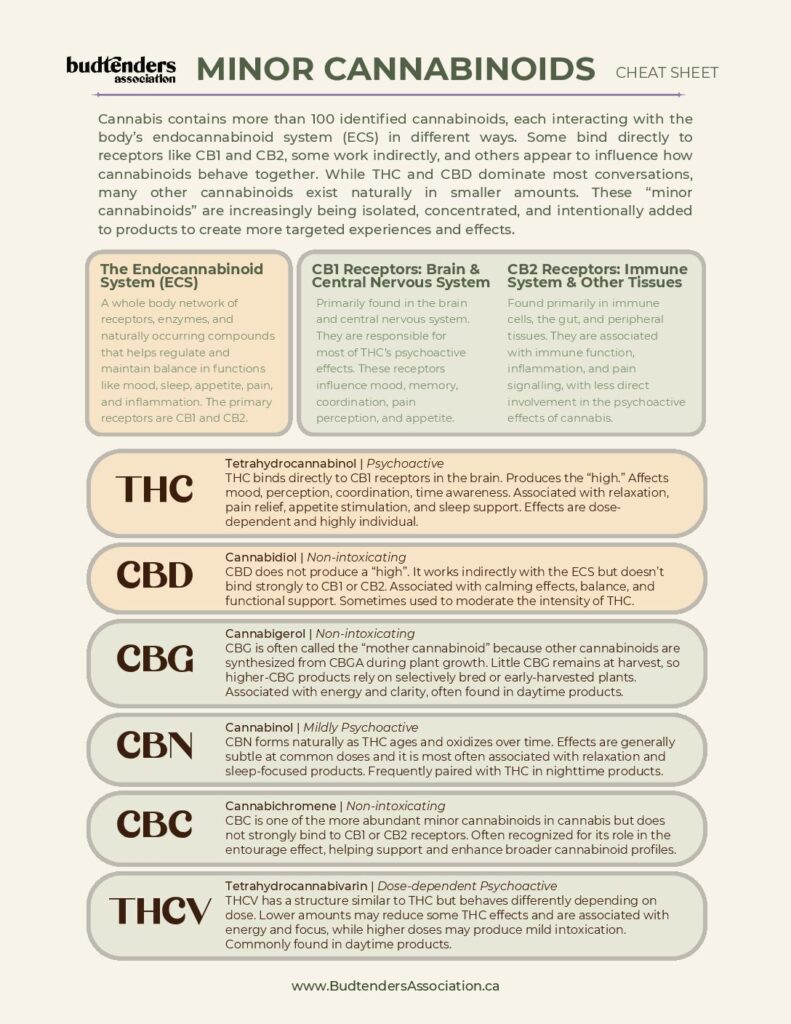
Before any cannabinoid makes sense, it helps to understand what it’s interacting with. The endocannabinoid system (ECS) is a network of receptors, enzymes, and naturally-occurring compounds spread throughout the brain and body. It plays a role in regulating things like mood, sleep, appetite, pain perception, and inflammation — essentially helping the body maintain balance.
The two main receptor types are CB1 and CB2. Cannabinoids from the cannabis plant, called phytocannabinoids, interact with these receptors by mimicking compounds the body already produces naturally.
CB1 Receptors: Brain & Central Nervous System
Concentrated in the brain and spinal cord. Primarily responsible for the psychoactive effects of THC. Influence mood, memory, coordination, pain perception, and appetite.
CB2 Receptors: Immune System & Peripheral Tissues
Found mostly in immune cells, the gut, and peripheral organs. Linked to inflammatory responses and immune regulation. Less directly tied to the “high.”
Cannabis contains more than 100 identified cannabinoids. Each one interacts with the ECS differently. Some bind directly to receptors, some work indirectly, and some appear to modulate how other cannabinoids behave. That’s exactly why two products with the same THC percentage can feel very different from one another.
THC & CBD: A Quick Refresher
These two are well known, but understanding them sets the context for everything else.
THC | Tetrahydrocannabinol
Psychoactive
- Binds directly to CB1 receptors in the brain
- Produces the “high” — affects mood, perception, coordination, time awareness
- Associated with relaxation, pain relief, appetite stimulation, and sleep support
- Effects are dose-dependent and highly individual
THC-A is the raw, unheated form. It’s non-psychoactive until it’s decarboxylated (heated), converting to THC through smoking, vaping, or cooking.
CBD | Cannabidiol
Non-intoxicating
- Does not produce a “high”
- Works indirectly with the ECS — doesn’t bind strongly to CB1 or CB2
- Associated with calming effects, balance, and functional support
- Often used to moderate the intensity of THC
CBD-A is CBD’s raw precursor, found in unheated cannabis. It converts to CBD when heat is applied.
The Five Key Minor Cannabinoids
Minor cannabinoids are present in smaller quantities in the cannabis plant, but they’re increasingly being concentrated and added to products intentionally. Understanding each one helps explain why products are formulated the way they are and helps customers make better choices.
CBG | Cannabigerol
“The Starting Point”
CBG is often called the “mother cannabinoid” because other cannabinoids, including THC and CBD, are actually synthesized from its acidic precursor, CBGA, during the plant’s growth cycle. By the time most cannabis is harvested, very little CBG remains naturally, which is why higher-CBG products use selectively bred or early-harvested plant material.
CBG is non-intoxicating. It interacts weakly with CB1 and CB2 receptors but has more pronounced effects on other receptor systems. Users and researchers commonly associate CBG with a clear, focused, functional quality. It’s understood to be less sedating than CBD and notably different in character.
Remember it: G is for Go — CBG is associated with energy and clarity, often found in daytime products.
CBN | Cannabinol
“The Night Shift”
CBN forms naturally as THC ages and breaks down over time through oxidation. It’s sometimes mildly psychoactive at higher concentrations, though at typical product dosages its effects are very subtle. CBN tends to prefer CB2 receptors and is most commonly found in nighttime and relaxation-focused products.
The “sleepy cannabinoid” reputation is well-established in cannabis culture, though research is still emerging. What’s notable is that CBN appears to work especially well in combination with THC. The two together tend to produce a heavier, more sedative quality than either alone. Many sleep-focused products deliberately combine them.
Remember it: N is for Night — CBN is the one that shows up in sleep and wind-down products.
CBC | Cannabichromene
“The Team Player”
CBC is one of the most abundant minor cannabinoids in the plant and is non-psychoactive. It’s not well known by consumers yet, but it plays a particularly interesting role in how cannabinoids work together. CBC doesn’t bind strongly to CB1 or CB2 receptors at all. Instead it appears to interact with other receptor systems in the body related to inflammation and discomfort.
What makes CBC stand out is its role in the entourage effect. It’s considered a strong synergistic partner with THC, CBD, and other cannabinoids, meaning it may help amplify or round out the effects of the broader cannabinoid profile in a product.
Remember it: C is for Crew — CBC rarely works alone, it’s a team player that amplifies what’s around it.
THCV | Tetrahydrocannabivarin
“The Spark”
THCV has a structure similar to THC but behaves differently depending on the dose. At lower amounts, it appears to act as a CB1 antagonist. This means it can actually dampen some of THC’s psychoactive effects rather than amplify them, while contributing an energizing, stimulating quality. At higher doses, it may produce its own mild intoxication.
THCV is naturally found in higher concentrations in certain African sativa landrace strains. It’s increasingly added to uplifting, daytime, and focus-oriented products. Some product descriptions associate it with a “clear-headed” energy — not sedating, not anxious-feeling.
Remember it: V is for Vivid and alert — THCV is the energising one, commonly in daytime and creative products.
CBDV | Cannabidivarin
“The Emerging One”
CBDV is structurally similar to CBD, like a slightly smaller version of the same molecule. It’s non-intoxicating and shares some receptor interactions with CBD, including effects on TRP channels (which are involved in how the body senses things like heat and inflammation). CBDV is more potent at CB2 receptors than at CB1.
Of all the minor cannabinoids, CBDV has the fewest products built around it yet, but it’s the one researchers are watching closely. It’s naturally more abundant in certain indica varieties from Asia and Africa. As research advances, CBDV products are expected to become more common on shelves.
Remember it: V for Version — CBDV is essentially CBD’s little cousin, still emerging but gaining attention fast.
Quick Ways to Remember Each One
You’ll be asked about these on the floor. Here are the one-word anchors.
CBG → Go / Green
Daytime, functional, clear-headed. G = Go.
CBN → Night
Born from aged THC. The wind-down cannabinoid. N = Night.
CBC → Crew
Non-psychoactive. Amplifies others. C = Crew player.
THCV → Vivid
THC’s energetic cousin. Low dose = stimulating. V = Vivid.
CBDV → Version
CBD’s smaller molecule cousin. Still emerging. V = Version 2.0.
How Different Cannabinoid Ratios Work
One of the biggest shifts in the cannabis market is the move toward intentional cannabinoid blends. Rather than optimising for the highest THC percentage, formulators are now combining cannabinoids in specific ratios to create more predictable, targeted experiences. Reading a ratio is a skill on its own.
How to read a ratio label:
THC : CBD : CBN — 2 : 1 : 1
→ The order matters. Cannabinoids are listed highest to lowest
→ The numbers show relative proportion, not milligrams
→ 2:1:1 means twice as much THC as each other cannabinoid
→ Check the total mg per serving for actual dose
Two-cannabinoid ratios (like THC:CBD) have been around for years. But the industry is now seeing a surge in tri-blend and multi-cannabinoid formulas. These combinations try to recreate some of the complexity of a whole-plant experience in a controlled, consistent product.
1:1 — THC : CBD
The Classic Balance
Approachable | Balanced |Versatile
The most established ratio in the market. CBD at equal parts can soften the intensity of THC, making for a smoother, more moderate experience. Often a good starting point for newer consumers who want some THC effect without going fully THC-forward.
2:1 — THC : CBN
Evening / Night
Relaxing | Wind-down
CBN alongside THC creates a notably heavier, more sedative quality than THC alone. The THC provides the primary effect and CBN adds what users often describe as a “weighted” relaxation. Very common in nighttime edibles and sleep-focused products. The 2:1 leans THC-forward; some products go 1:1 for a more even effect.
1:1 — THC : CBG
Daytime
Focus | Creative
CBG’s clear, functional character pairs with THC for a more alert, less foggy experience. Often described as a “creative” or “productive” combination, the THC opens things up mentally while the CBG helps maintain a thread of focus. Popular in daytime vapes and microdose products.
4:1:1 — THC:CBG:THCV
Daytime
Energizing | Active | Alert
A newer tri-blend gaining popularity in daytime vapes. THCV contributes an energizing, stimulating quality and may actually moderate some of THC’s heavier effects. CBG adds clarity. Together with THC, this combination is often described as the cannabis equivalent of a strong coffee — uplifting without the heaviness.
1:1:1 — THC:CBD:CBN
Evening
Complex | Balanced
Adding a third cannabinoid creates what formulators describe as a “rounder,” more complete experience. In this blend: THC provides the primary effect, CBD softens and balances, CBN adds the settling, relaxing weight. More complex than a two-cannabinoid product and less likely to feel one-dimensional. Great for consumers who’ve found straight THC too intense.
4:2:1:1 — CBD:THC:CBG:CBN
Anytime
Wellness | Low intoxication | Functional
CBD-dominant blends with supporting cannabinoids are increasingly common in wellness-positioned products. The high CBD base keeps intoxication low; CBG adds a functional clarity; CBN provides a gentle settling quality. This kind of profile is well-suited to consumers who want to feel the cannabis but not be heavily impaired.
Note: Ratios describe proportion, not intensity. A 1:1 THC:CBN product at 5mg total will feel very different from the same ratio at 20mg. Always consider the total dosage alongside the ratio.
The Entourage Effect: Why the Whole Is Greater Than the Sum of Its Parts
The term “entourage effect” was first introduced in 1998 to describe how multiple cannabis compounds working together can produce stronger or more nuanced effects than any single compound in isolation. It’s one of the key reasons full-spectrum products are often described as feeling richer or more complex than isolate-based products.
THC + CBD + CBG + CBN + CBC + Terps
All compounds interact. No single one works in isolation
Cannabinoids don’t just add up independently, they interact with each other and with terpenes (the aromatic compounds responsible for scent and flavour). Certain combinations appear to modify, enhance, or moderate each other’s effects. This is part of why two cannabis products with identical THC percentages can deliver completely different experiences.
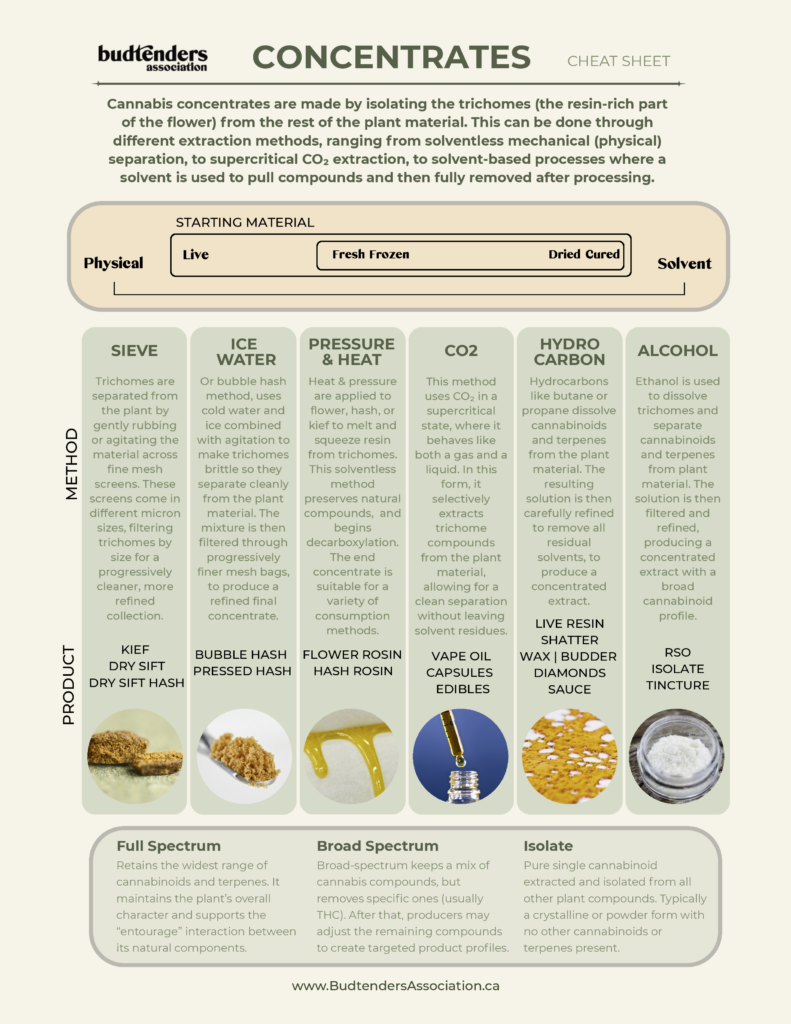
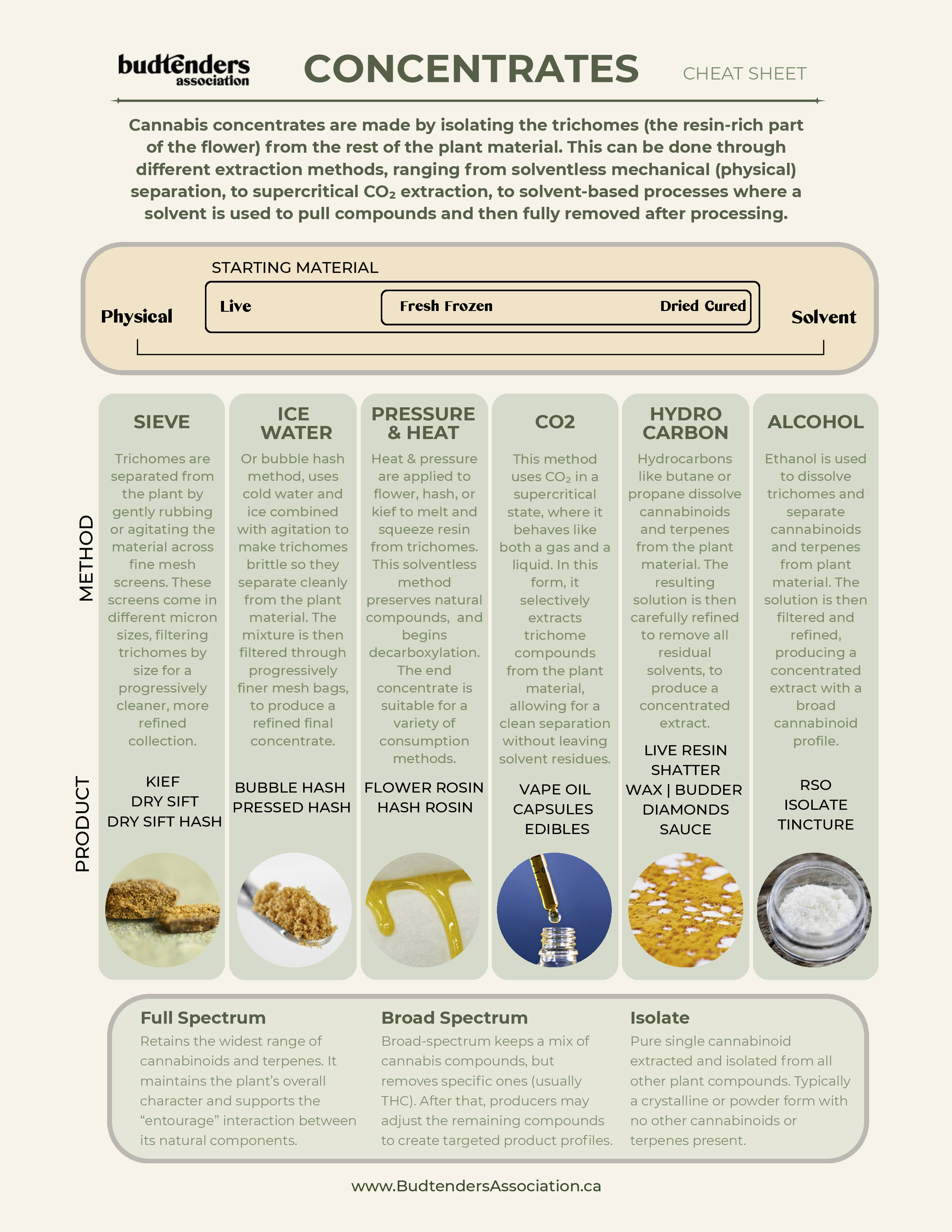
Full-Spectrum vs. Broad-Spectrum vs. Isolate
Understanding this distinction is useful when a customer asks why one product feels different from another with the same THC content.
Full-Spectrum
Contains THC, CBD, minor cannabinoids, terpenes, and other plant compounds. Maximum opportunity for entourage effect. Most complex experience.
Broad-Spectrum
Multiple cannabinoids and terpenes, but THC removed or reduced below detection. Retains some entourage benefit without the THC component.
Isolate
A single cannabinoid extracted and purified. Predictable and consistent but lacks the complexity of multi-compound products. No entourage effect.
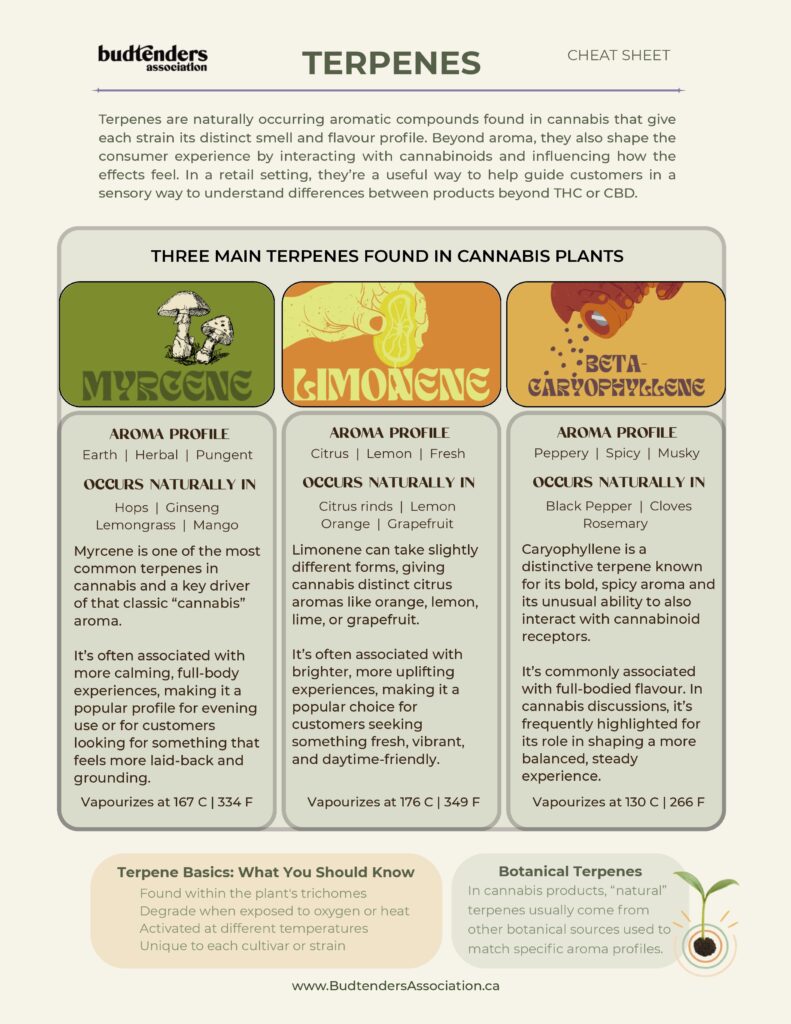
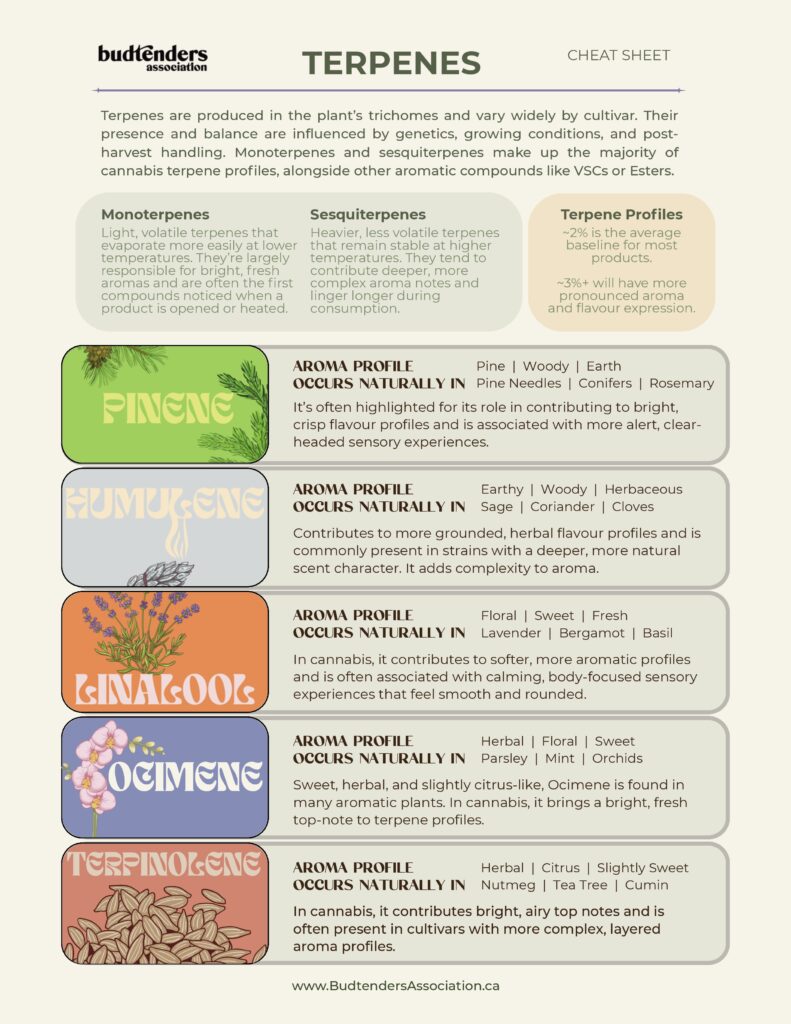
Terpenes also play a role. Compounds like myrcene (associated with earthy, relaxing qualities), limonene (citrusy, uplifting), and caryophyllene (peppery, grounding) don’t just create aroma. There’s exploratory evidence that they may interact with cannabinoid receptors and influence the overall character of an experience. The science is still developing, but it helps explain why two products with identical cannabinoid profiles can still smell and feel different.
Helping Customers Navigate Minor Cannabinoids
Most customers won’t come in asking for THCV by name. But they will describe what they’re looking for, and knowing the cannabinoid profiles lets you steer them toward the right product. Here are the most common conversations and how to frame them.
“I need help sleeping / winding down”
Look for products with CBN alongside THC. A 2:1 THC:CBN or a tri-blend with CBN included is a good place to start. The CBN adds a heavier, more settling quality to the THC effect.
“I want something for daytime / I don’t want to feel foggy”
CBG-forward products or THC:CBG blends lean functional and clear. If they want energy, THCV-containing products are worth mentioning. Full-spectrum over isolate for a more rounded experience.
“Same THC % as last time but it hits totally differently”
This is the entourage effect in action. Different terpene profiles, different minor cannabinoid content, same THC number, completely different experience. This is a great moment to explain why total cannabinoid profile matters more than any single number.
“What do these numbers on the label mean?”
Walk them through the ratio: the order lists cannabinoids highest to lowest proportion. Check the milligrams per serving for actual dose. A product with a 1:1:1 blend at 5mg each per serving is a light product; the same ratio at 15mg each is significantly stronger.
“What’s full-spectrum mean? Is it better?”
Not necessarily better for everyone, but it does offer more complexity due to the entourage effect. For consumers who want a predictable, consistent single-note experience, isolate or broad-spectrum products may actually suit them better.
“I want something creative / social / uplifting”
THC:CBG blends, THCV-containing products, or sativa-dominant terpene profiles. THCV in particular is often described as producing an alert, engaged quality without the heaviness that can sometimes accompany higher-THC products.
A note on language: Cannabis education is evolving, and so is the regulatory landscape. When discussing cannabinoids with customers, focus on the experiential and functional aspects of products rather than framing effects as treatments or remedies for specific conditions. The information in this guide is intended to help understand how cannabinoids work and how products are formulated — not to make medical claims.
Download Cheat Sheet Pdf
This is for budtender training and general consumer education. Information is based on current research and industry understanding as of 2025–2026. Cannabis science is an evolving field. New research continues to develop our understanding of how cannabinoids interact with the body. This guide does not constitute medical advice and is not intended to diagnose, treat, or prevent any condition.
Complete the quiz below for +200 points